Research Focus
Investigating the role of gut microbiota in gastrointestinal cancers, metabolic syndrome, and rare metabolic diseases, as well as their pathogenic mechanisms, and developing microbiota-based biomarkers and intervention strategies.
Using the microbiota as the core, conduct multiomics and phenomics research on the mentioned diseases and their sub-healthy populations. Establish their digital avatars for disease prediction and prevention.
The research mentioned above aims to develop a precision health research and development ecosystem that encompasses industry, academia, and research. This will expand the value of research and innovation from basic to clinical, from laboratory to patient care in hospital wards, and from hospitals to the community.
Recent Journal Publications
| Publication Date | Author | Paper Title | Abstract | Journal | SCI Impact Factor |
| December 2026 | Teng-Li Lin & Prof. Chun-Ying Wu et al. | Choosing real-world data for clinical and epidemiological research: methodological lessons from NHIRD and TriNetX-A narrative review | This review compares the features of the Taiwan NHIRD and the global TriNetX network, discussing their complementary strengths, limitations, and methodological strategies in real-world research. | Annals of Medicine | 4.3 |
| July 2026 | Hsin-Jou Lee & Assoc. Prof. Ting-Ting Chang et al. | Xaliproden improves diabetic kidney disease through JNK-mediated renal tubular protection | This study demonstrates that Xaliproden, a 5-HT1A receptor agonist, alleviates renal tubular epithelial injury and improves renal function in diabetic kidney disease via JNK pathway downregulation. | Biochemical Pharmacology | 5.6 |
| May 2026 | Wei-Ni Lyu & Prof. Chun-Ying Wu et al. | Intratumoral microbial networks as biomarkers for second primary oral cancer risk in esophageal squamous cell carcinoma | This study identifies specific intratumoral microbial interaction networks that can distinguish and predict the risk of second primary oral cancer (SPOC) in esophageal cancer survivors. | Scientific Reports | 4.9 |
| April 2026 | Gu BC & Prof. Chun-Ying Wu et al. | Rapid electrochemical profiling of fecal short chain acids using esterification/dissociation fingerprints and artificial neural networks | This study presents a rapid, machine-learning-assisted electrochemical platform integrating gold chips and artificial neural networks to achieve high-throughput profiling of fecal short-chain fatty acids. | Biosensors | 5.6 |
| April 2026 | Yi-Shan Liu & Prof. Chun-Ying Wu et al. | Objective and subjective assessments of the response of photobiomodulation therapy against alopecia areata | This study evaluates the efficacy of photobiomodulation therapy (PBMT) in alopecia areata, demonstrating significant hair regrowth and improved quality of life without adverse side effects. | Derm Ther | 3.4 |
| April 2026 | Chen YC & Assoc. Prof. Cheng-Yen Kao et al. | Multidrug-Resistant Klebsiella pneumoniae in a Pediatric ICU: Emergence of Newly Identified ST7120 and the First Report of ST792 in Taiwan. | This study reports a one-year cluster of multidrug-resistant Klebsiella pneumoniae in a PICU, identifying the first Taiwanese case of ST792 and a novel ST7120 strain, highlighting the importance of molecular surveillance. | New Microbes New Infect | 5.4 |
| April 2026 | Hung-Cheng Tsai & Asst. Prof. Li-Ling Wu et al. | Cumulative defined daily doses Enables Objective Assessment of Treatment Intensity and Outcome Prediction in IgG4-RD and Its subtypes | Quantitative cDDD assessment enables objective evaluation of treatment intensity and outcome prediction, supporting precision therapy for IgG4-RD. | Rheumatology | 4.7 |
| March 2026 | Asst. Prof. Li-Ling Wu et al. | Nfil3 integrates circadian rhythm and microbial metabolite signaling to maintain gut-liver immune-metabolic homeostasis under high-fat diet stress. | Supplementation with the probiotic VSL#3 attenuated multiple HFD-associated phenotypes, including body weight gain, impaired glucose tolerance, dyslipidemia, elevated transaminase levels, hepatic lipid accumulation, and increased intestinal epithelial permeability, while partially restoring the intrahepatic immune cell composition. | J Transl Med | 7.5 |
| March 2026 | Assoc. Prof. Ting-Ting Chang et al. | CCL7 suppression alleviates vascular injury by blocking the CCR5/STAT1 signaling pathway in chronic kidney disease | Patients with chronic kidney disease (CKD) are at a significantly increased risk of developing cardiovascular disease. | Life Sciences | 5.1 |
| March 2026 | Yi-Hui Yang & Prof. Chun-Ying Wu et al. | Assessing Major Adverse Liver Outcomes With Baclofen Compared to Acamprosate in Compensated Alcohol-Associated Cirrhosis | After matching, a total of 571 baclofen initiators and 571 acamprosate initiators were included in the analysis. The 1-year incidence of MALO was higher in the baclofen group (34.3%) than in the acamprosate group (27.4%), with a hazard ratio (HR) of 1.32 (95% CI, 1.02–1.70). Among individual events, baclofen use was associated with an increased risk of hepatic encephalopathy (HR 1.80; 95% CI, 1.21–2.69). No significant differences were observed in other events or mortality. Subgroup analyses suggested a higher risk among patients aged 56–70 years. | Aliment Pharmacol Ther | 6.7 |
| March 2026 | Prof. Chun-Ying Wu & Teng-Li Lin et al. | Real-World Safety of JAK Inhibitors in Skin Immune-Mediated Inflammatory Diseases: Boxed Warning Outcomes from a Multinational Cohort Study. | Among patients with immune-mediated inflammatory skin diseases (IMIDs), Janus kinase (JAK) inhibitors were not associated with increased risks of mortality, major adverse cardiovascular events (MACE), venous thromboembolism, or malignancy within 2 years compared with conventional systemic therapies. | Clin Pharmacol Ther | 5.5 |
| March 2026 | Prof. Chun-Ying Wu & Teng-Li Lin et al. | Validated nationwide scoring system for hepatocellular carcinoma risk in metabolic dysfunction-associated steatotic liver disease. | The CAMD score is an easily calculable tool that may facilitate large-scale hepatocellular carcinoma (HCC) surveillance in patients with MASLD. | Liver International | 5.2 |
| March 2026 | Assoc. Prof. Li-Lin Liang et al. | Mandated capacity reductions created new gender disparities in liver cancer surveillance: a population-based cohort study | Even in settings with very few COVID-19 cases, government-mandated reductions in healthcare resources resulted in severe and long-term surveillance gaps. These policies generated new and persistent gender inequalities and were associated with delays in cancer screening within the universal healthcare system. Crisis response planning must incorporate health equity impact assessments to prevent unintended harm. Gender-sensitive strategies are urgently needed to re-engage women in preventive healthcare. | International Journal for Equity in Health | 4.1 |
| February 2026 | Assoc. Prof. Ting-Ting Chang et al. | Inhibition of CCL4 prevents renal inflammation and fibrosis in acute kidney injury. | Acute kidney injury (AKI) is a common clinical condition associated with high morbidity and mortality, with ischemia/reperfusion (I/R)- and sepsis-induced AKI being particularly prevalent. Chemokine C-C motif ligand 4 (CCL4), a pro-inflammatory chemokine, is upregulated in kidney diseases. This study investigated the role of CCL4 in the pathogenesis of AKI, focusing on its potential to regulate inflammatory and fibrotic responses through the signal transducer and activator of transcription 3 (STAT3) signaling pathway. The findings suggest that CCL4 plays a critical role in the pathophysiology of AKI, particularly in STAT3-mediated inflammation and fibrosis. Our results indicate that targeting CCL4 may represent a novel therapeutic strategy for alleviating AKI and preventing its progression to chronic kidney disease. | Clinical Science | 7.7 |
| February 2026 | Asst. Prof. Li-Ling Wu et al. | Comparative analysis of renal dysfunction, immune remodeling, and gut microbiota profiles in dietary models of metabolic liver disease | 不同的營養成分在腸-肝-腎軸上引發了不同的免疫代謝和微生物反應。高脂飲食(HFD)和低脂高糖飲食(CDAHFD)在小鼠中產生了不同的肝臟、腎臟、免疫和微生物表型,顯示其代謝損傷機制獨特,而非疾病的同步階段。儘管未直接評估器官間的機制性通訊,但此比較框架強調了在解釋實驗性MASLD模型的多器官結局時,飲食成分 and 損傷動力學的重要性。 | BMC Nephrology | 2.4 |
| February 2026 | Asst. Prof. Li-Ling Wu et al. | FK506-binding protein five deficiency influences gut microbiota, gut barrier, and hepatic immune-metabolic coordination in high fat diet-induced metabolic-associated fatty liver disease | KBP5 contributes to compensating for insufficient immune responses within the gut microbiota and counteracts obesity by improving gut microbial responses to HFD-induced metabolic dysfunction-associated steatotic liver disease (MASLD). | Scientific Reports | 3.9 |
| February 2026 | Chen CJ & Assoc. Prof. Cheng-Yen Kao et al. | Genotypes, antibiotic resistance, and virulence diversity among Klebsiella pneumoniae species complex isolates in Taiwan. | Klebsiella pneumoniae, Klebsiella quasipneumoniae, and Klebsiella variicola exhibited distinct genotypic and phenotypic characteristics. K. quasipneumoniae and K. variicola demonstrated higher mortality rates in the larval infection model, highlighting the importance of continuous surveillance of their dissemination., K. quasipneumoniae K. quasipneumoniae ) and K. variicola exhibited distinct genotypic and phenotypic characteristics.K. quasipneumoniaeandK. variicolademonstrated higher mortality rates in the larval infection model, highlighting the importance of continuous surveillance of their dissemination. | Gut Pathogens | 4 |
| February 2026 | Yi-Ju Chen, Siou-Rong He, Jing-Hong Tseng, Chen YF, Shieh JJ, Chun-Ying Wu | Akkermansia muciniphila ameliorates imiquimod-induced skin thickening, colitis, and gut microbiota alterations: a metagenome association study. | pAkkmaymay alleviate IMQ-induced skin thickening and DSS-induced colitis, accompanied by reduced TNF-α and IL-17A levels. p AkkAkk supplementation can alter the fecal microbiota and metabolic pathways of IMQ-treated mice. | Inflammation | 5 |
| February 2026 | Duong TTT & Assoc. Prof. Cheng-Yen Kao et al. | A combined genetic and phenotypic marker approach enables precise detection of hypervirulent Klebsiella pneumoniae and reveals associated traits of capsule overproduction and tellurite resistance. | This study integrated genotypic and phenotypic analyses to identify biomarkers for detecting hypervirulent Klebsiella pneumoniae (hvKp). The results demonstrated that a combined assay targeting five virulence genes (peg-344, iroB, iucA, rmpA, and rmpA2) effectively discriminated hvKp and was strongly associated with increased capsule production and virulence. | Microbiol Spectr | 3.8 |
| February 2026 | Yueh-Jung Chao & Assoc. Prof. Cheng-Yen Kao et al. | Hha toxin regulates diverse phenotypes of uropathogenic Proteus mirabilis including virulence | The Hha protein in the toxin–antitoxin (TA) system of Proteus mirabilis contributes to bacterial virulence and is regulated by the copper-responsive regulator CpxR. This study demonstrated that Hha may serve as a potential therapeutic target for urinary tract infections caused by P. mirabilis and provides new insights into exploiting TA systems to control bacterial virulence. | J Microbiol Immunol Infect | 3.7 |
| February 2026 | Wu-Chun Chung & Prof. Che-Lun Hung et al. | Decentralized Federated Learning with Non-IID Data: Challenges, Trends, and Future Opportunities | This study conducted a systematic literature review (SLR) of decentralized federated learning research under non-independent and identically distributed (non-IID) environments. Through structured analyses of the literature, experimental settings, and evaluation practices, this review highlighted key trends, identified research gaps, and proposed future directions for advancing decentralized federated learning (DFL) in non-IID settings. | ACM Computing Surveys | 28 |
| January 2026 | Zhang M & Prof. Chun-Ying Wu et al. | Unbiased clustering of acute-on-chronic liver failure patients using machine learning in a real-world ICU cohort. | Using unsupervised clustering analysis in 1,256 patients with acute-on-chronic liver failure (ACLF), this study successfully identified two clinically distinct subgroups with significantly different 30-day mortality rates (approximately 70% vs. 26%). The results indicated that acid–base balance–related parameters, including bicarbonate, pH, lactate, and anion gap, were key clustering factors, and external validation further supported their importance in prognostic prediction and risk stratification. The results indicated that acid–base balance–related parameters, including bicarbonate, pH, lactate, and anion gap, were key clustering factors, and external validation further supported their importance in prognostic prediction and risk stratification. | Nature Communication | 15.7 |
| January 2026 | Fan YH & Assoc. Prof. Cheng-Yen Kao et al. | Emergence of conjugative metallo-β-lactamase-encoding plasmids in the Klebsiella pneumoniae species complex: First identification of IMP-8-MCR-9.1 in K. quasipneumoniae and VIM-1 in K. variicola in Taiwan | This study is the first report in Taiwan identifying transmissible carbapenemase-bearing plasmids in K. quasipneumoniae and K. variicola. Their recombination and dissemination warrant continuous close surveillance. | Journal of Infection and Public Health | 4 |
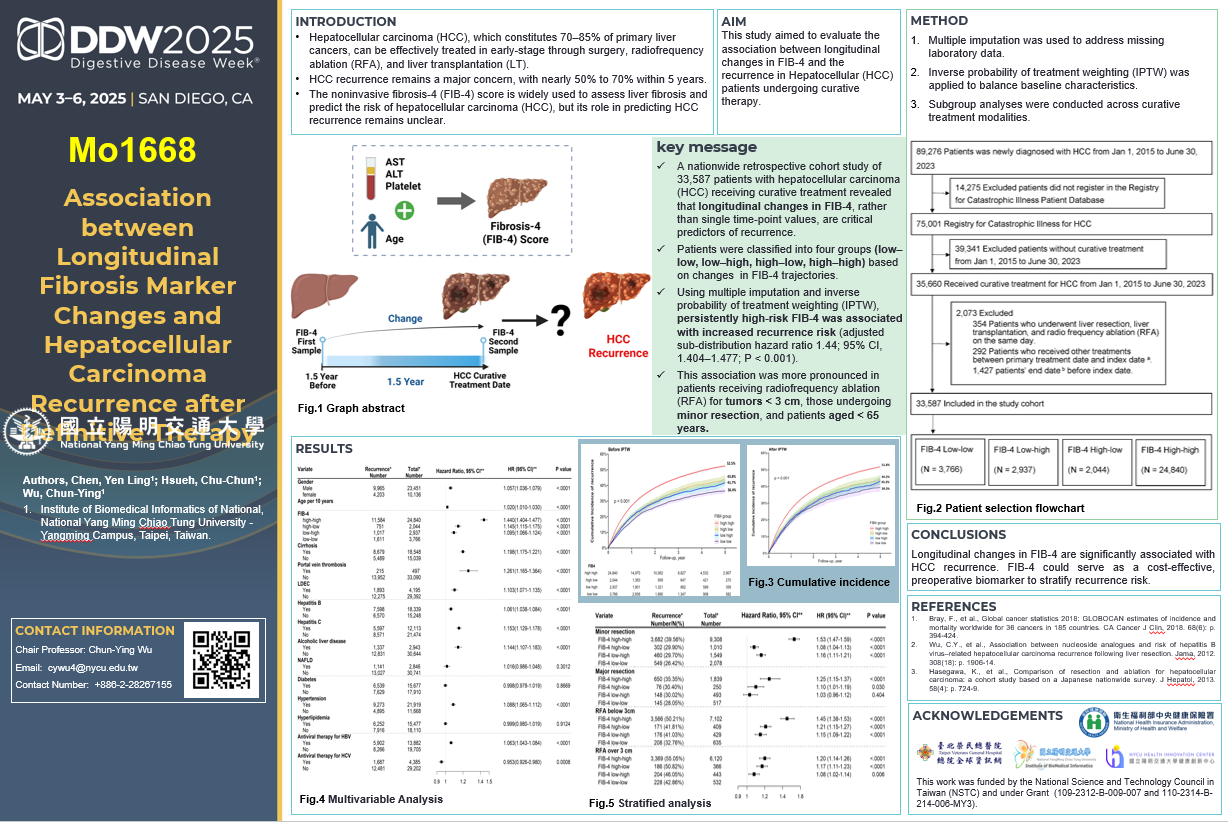
| January 2026 | Yi-Hui Yang & Prof. Chun-Ying Wu et al. | Dynamic FIB-4 score changes and HCC risk in patients with MASLD and elevated liver enzymes: a nationwide cohort study. | Longitudinal monitoring of changes in the FIB-4 score predicted hepatocellular carcinoma (HCC) risk more accurately than a single measurement. In Asian patients with non-cirrhotic MASLD and elevated liver enzymes, regular FIB-4 monitoring may help identify high-risk populations. | Liver Cancer | 9.1 |
| January 2026 | Prof. Chun-Ying Wu & Teng-Li Lin et al. | Psoriatic arthritis risk in psoriasis patients receiving anti-IL-23 vs anti-IL-17: comparison of drug classes and individual agents. | Compared with IL-17 inhibitors (IL17i), psoriasis (PsO) patients receiving IL-23 inhibitors (IL23i) had a significantly lower risk of developing psoriatic arthritis (PsA) over a 5-year period, and this difference was consistent across age, sex, race, and clinical subgroups. These findings suggest that IL23i treatment is associated with a lower risk of PsA development compared with IL17i, indicating a potential advantage in PsA prevention. These findings suggest that IL23i treatment is associated with a lower risk of PsA development compared with IL17i, indicating a potential advantage in PsA prevention. | Rheumatology | 4.4 |
| December 2025 (accepted) | Assoc. Prof. Ting-Ting Chang et al. | Sodium nitroprusside improves ischemia-induced neovascularization via the HO-1/NOX and AKT/eNOS signaling pathways in chronic kidney disease. Life Sciences. | SNP treatment upregulated circulating pro-angiogenic factors, improved blood flow recovery, increased microvascular density, and reversed the expression of pro-angiogenic and inflammatory proteins in ischemic tissues, although it failed to restore renal function in chronic kidney disease (CKD) mice. This study provides a theoretical basis for the use of SNP as a potential therapeutic intervention in CKD patients with vascular complications. | Life Sciences | 5.1 |
| November 2025 (accepted) | Yi-Hui Yang & Prof. Chun-Ying Wu et al. | Dynamic FIB-4 score changes and HCC risk in patients with MASLD and elevated liver enzymes: a nationwide cohort study. | In non-cirrhotic MASLD patients with elevated liver enzymes, longitudinal changes in the FIB-4 score over three consecutive years predicted hepatocellular carcinoma (HCC) risk more accurately than a single measurement. Patients with persistently high FIB-4 scores had the highest risk, whereas worsening scores were associated with increased risk and improving scores with reduced risk, suggesting its utility in identifying high-risk populations requiring intensified surveillance. | Liver Cancer | 9.1 |
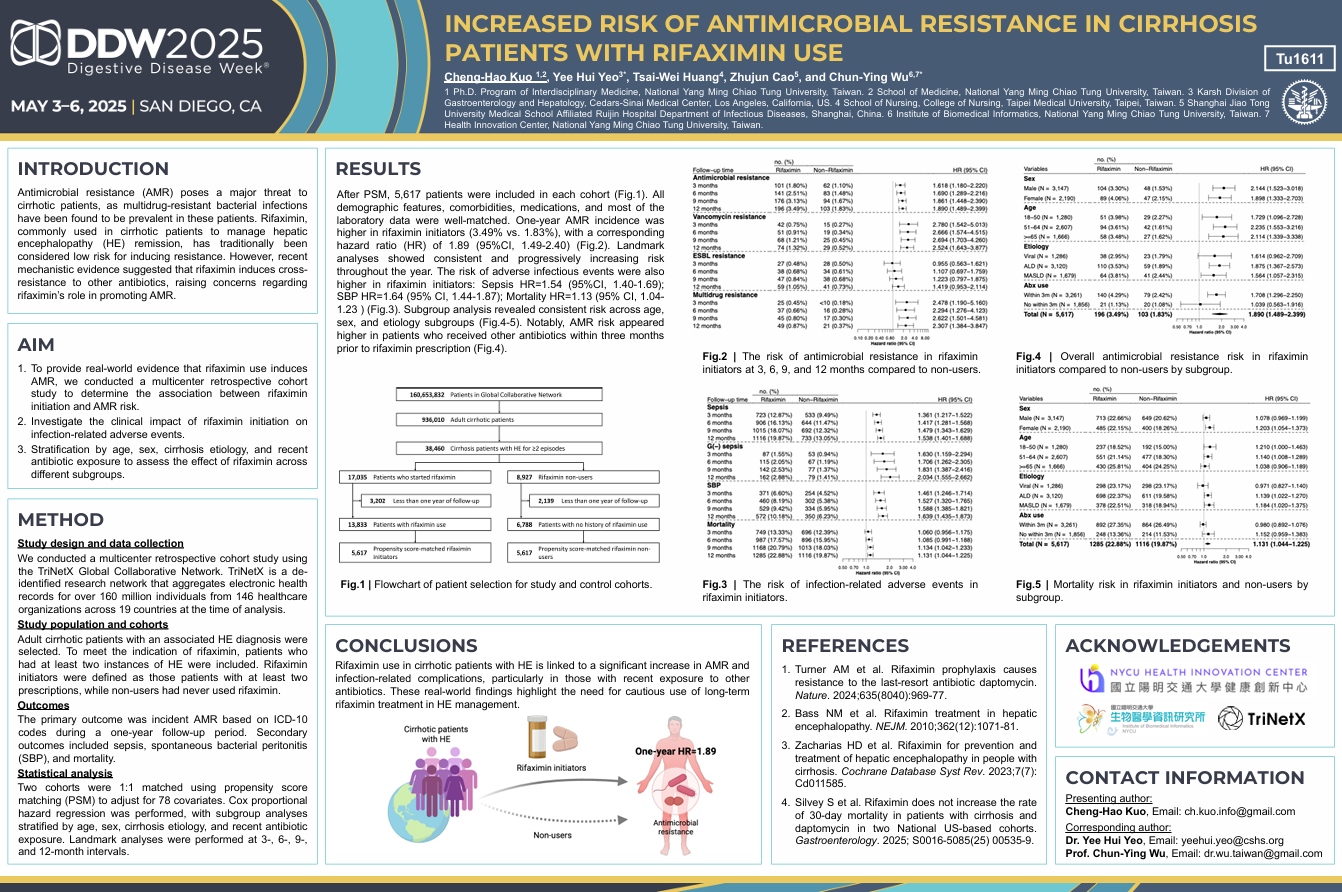
| November 2025 (accepted) | Prof. Chun-Ying Wu & Cheng-Hao Kuo et al. | Increased risk of antimicrobial resistance in patients with cirrhosis and hepatic encephalopathy using rifaximin | This study evaluated whether the use of Rifaximin in patients with cirrhosis complicated by hepatic encephalopathy increases the risk of antibiotic resistance. The findings revealed that Rifaximin use was associated with a higher risk of sepsis, spontaneous bacterial peritonitis, and the need for last-line antibiotics. | Nature Communication | 15.7 |
| October 17, 2025 | Prof. Chun-Ying Wu & Teng-Li Lin et al. | Psoriatic arthritis risk in psoriasis patients receiving anti-IL-23 vs anti-IL-17: comparison of drug classes and individual agents | This study compared the risk of developing psoriatic arthritis (PsA) in patients with psoriasis treated with IL-23 inhibitors versus IL-17 inhibitors. Among 5,490 matched patients (1:1 matching), users of IL-23 inhibitors showed a significantly lower 5-year cumulative incidence of PsA (11.68% vs. 19.94%), with a hazard ratio of 0.475. Subgroup analyses and comparisons across individual agents demonstrated consistent results, indicating that IL-23 inhibitors are associated with a reduced risk of subsequent PsA development compared with IL-17 inhibitors in patients with psoriasis. | Rheumatology | 4.4 |
| October 11, 2025 | Dr. Jing-Hong Tseng & Prof. Chun-Ying Wu | From dysbiosis to longevity: a narrative review into the gut microbiome’s impact on aging. | The gut microbiome is an important and modifiable factor influencing aging, and animal studies have demonstrated its causal impact on lifespan and the aging process. In humans, the gut microbial composition evolves with age, diet, lifestyle, hormonal changes, and immune function, and it modulates late-life health through the gut–muscle and gut–brain axes. Individuals with exceptional longevity typically exhibit greater microbial diversity and better gut homeostasis. High-fiber diets, regular exercise, and interventions involving probiotics, prebiotics, or postbiotics may help promote healthy aging; however, further research is needed to optimize these strategies. | J Biomed Sci | 12.1 |
| September 5, 2025 | Dr. Chih-Ming Liu & Prof. Chun-Ying Wu et al. | Screening and eradication of Helicobacter pylori for gastric cancer prevention: Taipei Global Consensus II. | An international panel of experts reached 28 consensus statements using the GRADE and Delphi methodologies, confirming that eradication of Helicobacter pylori effectively reduces gastric cancer risk across all age groups, with the greatest benefit achieved before the development of precancerous lesions. The consensus recommends prioritizing screening in high-risk populations, utilizing the ^13C-urea breath test or monoclonal stool antigen testing, and adopting empirical therapies such as bismuth quadruple therapy in regions with high antibiotic resistance. Post-treatment confirmation testing is strongly advised. Future research should aim to clarify the optimal timing for screening, elucidate the long-term effects of treatment on the microbiome and antimicrobial resistance, and advance the development of vaccines as well as more precise individualized risk-stratification strategies. | Gut | 25.8 |
| September 1, 2025 | Yi-Hui Yang & Prof. Chun-Ying Wu et al. | Predictive machine learning model in intensive care unit patients with acute-on-chronic liver failure and two or more organ failures | Using a large intensive care unit database, this study developed and interpreted machine learning models to predict 30-day mortality in patients with acute-on-chronic liver failure who presented with failure of two or more organ systems. CatBoost and Random Forest achieved the best performance within the NACSELD and EASL-CLIF classifications, with AUCs of 0.87 and 0.83, respectively. The models remained highly accurate even after SHAP-based interpretation and simplification, outperforming existing scoring systems. The models were internally and externally validated with good calibration, and an accessible online prediction tool has been developed to facilitate rapid clinical assessment of mortality risk. | Clin Mol Hepatol | 16.9 |
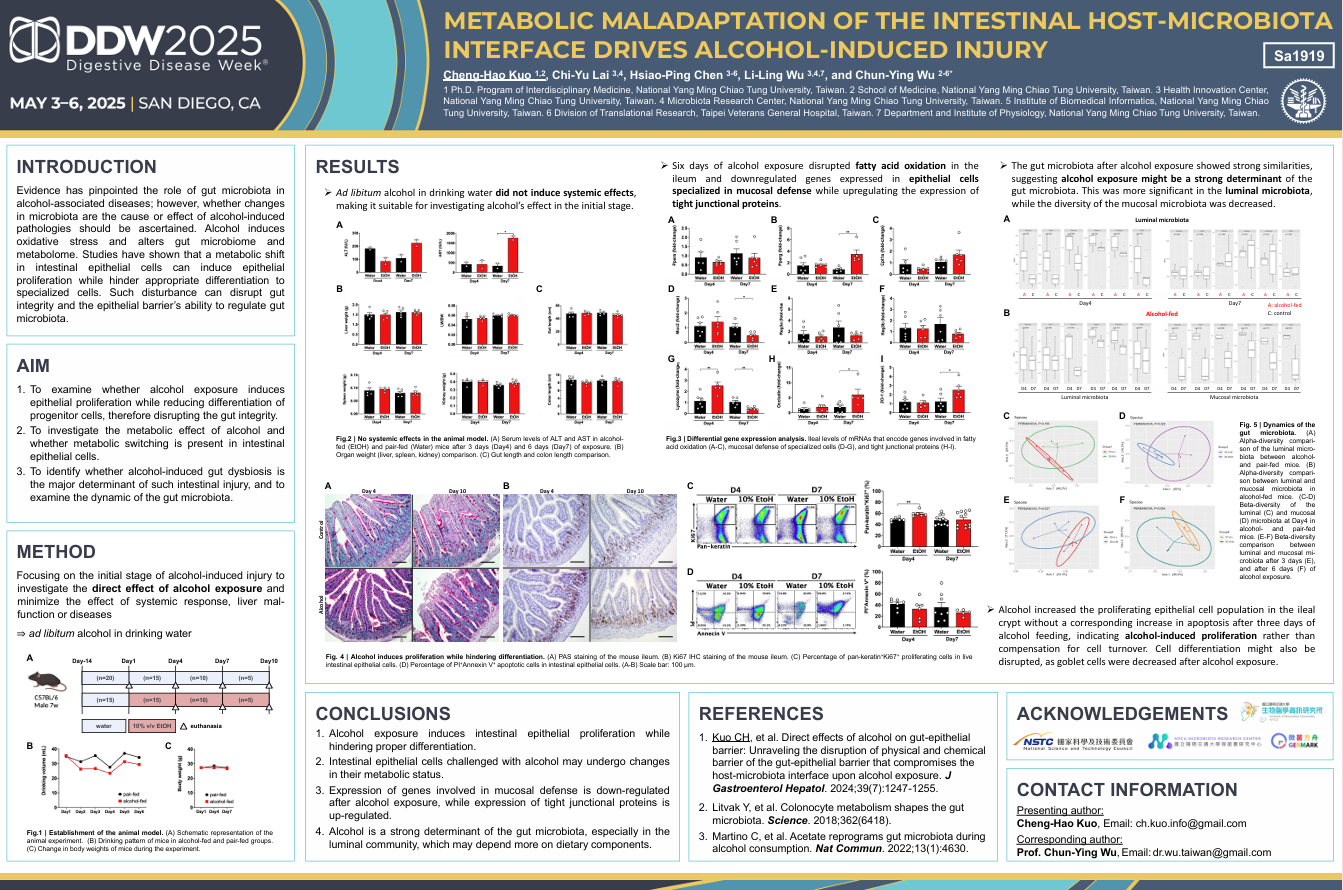
| September 2025 | Prof. Chun-Ying Wu & Cheng-Hao Kuo et al. | Composition and metabolomic shifts of the gut microbiome in alcohol-related liver disease. | Alcohol-associated liver disease (ALD) is not solely a liver disorder but also involves dysfunction of the gut–liver axis, with alcohol-induced gut dysbiosis playing a pivotal role. This article reviews the alterations in the gut microbiota following alcohol exposure and examines how microbially derived metabolites—such as fatty acids, tryptophan derivatives, and secondary bile acids—affect intestinal barrier integrity, immune responses, and metabolic pathways, thereby exacerbating liver injury. Advances in multi-omics technologies and microbiome-modulating strategies hold promise for elucidating host–microbe interactions and identifying novel therapeutic targets for ALD. | J Gastroenterol Hepatol | 3.4 |
| August 1, 2025 | Prof. Chun-Ying Wu & Teng-Li Lin et al. | Psoriasis risk in patients with atopic dermatitis treated with dupilumab. | This large retrospective study compared the outcomes of patients with atopic dermatitis treated with dupilumab versus other systemic therapies and found a higher incidence of psoriasis among dupilumab users. Over a 3-year follow-up, the cumulative incidence of psoriasis was 2.86% in the dupilumab group, significantly higher than 1.79% in the control group, corresponding to a hazard ratio of 1.58. Although dupilumab use is associated with an increased relative risk of psoriasis, the absolute risk remains low (NNH = 94). Clinicians should therefore balance the potential adverse effects against the therapeutic benefits when considering dupilumab treatment. | JAMA Dermatology | 11.0 |
| May 21, 2025 | Prof. Chun-Ying Wu, Prof. Che-Lun Hung & Chien-An Chen et al. | Identifying disinformation on the extended impacts of COVID-19: methodological investigation using a fuzzy ranking ensemble of natural language processing models. | This study developed a deep learning framework that integrates a pretrained language model with a fuzzy ranking ensemble method to detect misinformation related to long COVID. Experimental results demonstrated that XLNet and its fuzzy-ranking-based ensemble variants outperformed traditional approaches, achieving a high accuracy of 93.52%. The findings indicate that relying solely on textual information can effectively enhance misinformation detection performance, offering meaningful implications for public health policy and communication. | J Med Internet Res | 6.0 |
| April 17, 2025 | Prof. Chun-Ying Wu & Teng-Li Lin et al. | Cardiovascular disease risk in patients with psoriasis receiving biologics targeting | This study found that, compared with oral systemic agents, psoriasis patients treated with biologics had a significantly lower risk of cardiovascular disease. Specifically, therapies targeting TNF-α, IL-17, and IL-23 were associated with reduced cardiovascular risk, whereas IL-12/23 inhibitors showed no significant difference. These findings were consistent across age, sex, geographic regions, and comorbidity subgroups, supporting the potential cardiovascular benefits of biologic therapies in the management of psoriasis. | PLOS Medicine | 10.5 |
| April 7, 2025 | Prof. Chun-Ying Wu et al. | The development of live biotherapeutic products: a position statement of Asia-Pacific Microbiota Consortium. | This study summarizes consensus recommendations from gut microbiome experts in the Asia-Pacific region regarding the development of live biotherapeutic products (LBPs), covering three key domains: development rationale, preclinical research, and clinical readiness. The experts recommend prioritizing strains derived from humans or food sources, and emphasize rigorous functional characterization, genetic monitoring, and safety assessment throughout the development process. Clinical trials should be carefully designed and incorporate comprehensive risk management to ensure both safety and efficacy of LBP products | Gastroenterology & Hepatology | 23.0 |
| December 23, 2024 | Prof. Chun-Ying Wu & Prof. Chen-Yi Wu et al. | Association between Air Quality Index and the risk of rosacea: a nationwide population-based cohort study | This study demonstrated a significant positive association between the Air Quality Index (AQI) and the risk of rosacea. Each one-unit increase in AQI corresponded to a 5% increase in rosacea risk. Higher AQI categories were associated with markedly elevated risks, with the highest quartile showing a 7.22-fold increase compared with the lowest. Exposure to PM2.5, sulfur dioxide (SO₂), and carbon monoxide was associated with increased risk, whereas PM10 exposure was linked to lower risk. | Clin Exp Dermatol | 3.7 |
| November 28, 2024 | Prof. Chun-Ying Wu & Teng-Li Lin et al. | Dupilumab impact on psychiatric and sleep disorder risk reduction in atopic dermatitis: A population-based cohort study | This study found that, compared with conventional systemic treatments, patients with atopic dermatitis who received dupilumab had significantly lower 3-year risks of anxiety, depression, adjustment disorder, and sleep disorders. These associations were consistent across age, sex, race, and comorbidity subgroups, with particularly pronounced benefits observed among African American patients. Attention-deficit/hyperactivity disorder (ADHD) was the only outcome for which the risk difference was not statistically significant. | Ann Allergy Asthma Immunol | 5.8 |
| November 25, 2024 | Assoc. Prof. Li-Lin Liang et al. | Taiwan case study: balancing health and economy during COVID-19. | This study evaluated the performance of Taiwan’s government during the COVID-19 pandemic across health, economic, and social dimensions. Taiwan achieved remarkable success in the early phase of the pandemic, maintaining strong public health outcomes and demonstrating economic resilience. However, later phases showed declines in health indicators, widening income inequality, increases in domestic violence, and a decrease in birth rates. These findings provide important insights and lessons for future pandemic preparedness and policy planning. | Asian Pacific Journal of Health Economics and Policy. | |
| November 24, 2024 | Prof. Chun-Ying Wu et al. | Automatic localization and deep convolutional generative adversarial network-based classification of focal liver lesions in computed tomography images: A preliminary study | This study developed a deep learning–based Liver Lesion Localization and Classification (DLLC) system designed to assist physicians in interpreting local liver lesions in CT images. The system achieved an average localization precision of 0.81 and a classification accuracy of 0.97, with an accuracy of 0.83 for lesions smaller than 3 cm and 0.87 for lesions larger than 3 cm. This system provides an accurate and non-invasive diagnostic approach, offering significant value to hepatologists and radiologists. | Journal of Gastroenterology and Hepatology | 3.7 |
| October 22, 2024 | Assoc. Prof. Li-Lin Liang et al. | The Role of Digital Health Under Taiwan’s National Health Insurance System: Progress and Challenges | Digital health encompasses the application of digital technologies in the medical field, playing a crucial role in improving the accessibility, quality, and efficiency of healthcare services. This study examines digital health under Taiwan’s National Health Insurance, particularly its impact during the COVID-19 pandemic, focusing on big data management and analytics (such as MediCloud and My Health Bank/NHI Mobile Easy Access) as well as innovative service models (such as telemedicine). The study indicates that individuals with higher income and those with chronic or severe conditions are more likely to use telemedicine, and it highlights challenges related to digital trust and the digital divide. | Health systems and reform | |
| July 30, 2024 | Prof. Chun-Ying Wu et al. | Short-chain fatty acids ameliorate imiquimod-induced skin thickening and IL-17 levels and alter gut microbiota in mice: a metagenomic association analysis | This study investigated the effects of short-chain fatty acids (SCFAs) on skin phenotype, systemic inflammation, and gut microbiota in mice with psoriasis-like symptoms. Imiquimod (IMQ)-treated mice were used as the model, and genomic analyses were conducted to examine the impact of SCFAs or anti–IL-17 antibodies on skin thickness, inflammatory markers, and fecal microbiota. The results showed that SCFAs ameliorated IMQ-induced skin thickening, spleen enlargement, and serum IL-17F levels, with effects comparable to anti–IL-17 treatment. SCFAs also increased microbial diversity and altered gut microbiota composition, suggesting associations with carbohydrate degradation and phenylalanine metabolism. | Scientific reports | |
| July 27, 2024 | Prof. Chen-Yi Wu et al. | Association between Air Quality Index and the risk of rosacea: a nationwide population-based cohort study | This study investigated the relationship between the Air Quality Index (AQI) and the incidence of rosacea. Using data from 21,709,479 individuals in Taiwan’s National Health Insurance Research Database, the analysis revealed that each one-unit increase in AQI was associated with a 5% increase in rosacea risk. Participants were stratified into four AQI groups, and higher AQI levels were significantly associated with increased risk of rosacea (Q2: 1.82-fold; Q3: 4.48-fold; Q4: 7.22-fold). Exposure to PM2.5, sulfur dioxide (SO₂), and carbon monoxide was also linked to higher risk, whereas PM10 exposure was associated with lower risk. These findings demonstrate a significant dose–response relationship between AQI and rosacea incidence. | Clinical And Experimental Dermatology | 3.7 |
| July 23, 2024 | Prof. Chun-Ying Wu et al. | Clinical guidelines for early hepatocellular carcinoma treatment options: a systematic review and bibliometric analysis | This study systematically reviewed 23 clinical guidelines from major hepatology societies published between 2017 and 2024 to analyze changes in recommendations regarding radiofrequency ablation (RFA) and surgical resection in the treatment of early-stage hepatocellular carcinoma (HCC). The results showed increasing support for the use of RFA in selected patient populations, while surgical resection continued to receive strong recommendations due to its robust evidence base. The 2023 Japanese guideline received the highest quality rating, although stakeholder involvement remained generally limited across guidelines. The study underscores the need for continuous updates to clinical guidelines and calls for high-quality head-to-head comparative studies to further optimize treatment strategies for early-stage HCC. | International journal of surgery | 12.5 |
| July 17, 2024 | Prof. Chun-Ying Wu et al. | Liver resection had better disease-free survival rates compared with radiofrequency ablation in hepatocellular carcinoma: a meta-analysis based on randomized clinical trials | This study compared liver resection (LR) with radiofrequency ablation (RFA) for the treatment of early-stage hepatocellular carcinoma (ES-HCC) through a meta-analysis of randomized controlled trials. A systematic search identified nine RCTs involving 1,516 patients. The results showed no significant differences in 2-year and 5-year overall survival (OS) between LR and RFA. However, LR demonstrated a trend toward improved disease-free survival (DFS) at 2 years (HR = 1.40) and 5 years (HR = 1.37), though statistical power was limited. Overall heterogeneity was low, supporting the reliability of the findings. The study concludes that larger RCTs are needed to clarify the comparative efficacy of LR and RFA in ES-HCC. | International journal of surgery | 12.5 |
| June 14, 2024 | Prof. Chun-Ying Wu & Teng-Li Lin et al. | Reduced atopic march risk in pediatric atopic dermatitis patients prescribed dupilumab versus conventional immunomodulatory therapy: A population-based cohort study | This study evaluated the effectiveness of dupilumab in preventing allergic progression (i.e., development of allergic asthma or allergic rhinitis) among pediatric patients with atopic dermatitis (AD), compared with traditional immunomodulators. Using a retrospective cohort of 2,192 patients, the analysis showed that the 3-year cumulative incidence of allergic progression was significantly lower in the dupilumab group than in the conventional therapy group (20.09% vs. 27.22%; P < .001). Dupilumab treatment was associated with significantly reduced risks of overall allergic progression, asthma, and allergic rhinitis (hazard ratios 0.68, 0.60, and 0.69, respectively). Younger patients appeared to benefit the most. | Journal of the American Academy of Dermatology | 12.8 |
| June 12, 2024 | Dr. Chien-Wei Su et al. | The association between proton-pump inhibitor use and recurrence of hepatocellular carcinoma after hepatectomy | This study investigated the association between long-term proton pump inhibitor (PPI) use and recurrence after surgical resection of hepatocellular carcinoma (HCC). A total of 6,037 patients who underwent hepatectomy were categorized into four groups based on cumulative PPI dosage. PPI users had significantly longer median recurrence-free survival (RFS) compared with non-users (adjusted hazard ratio [aHR] 0.57, P < 0.001). Patients with long-term PPI use (≥180 cDDD) exhibited an even greater reduction in recurrence risk (aHR 0.50, P < 0.001). However, PPI use showed no significant association with overall survival (OS). The findings suggest that long-term PPI use may be linked to improved RFS following HCC resection. | Journal of gastroenterology and hepatology | 3.7 |
| June 12, 2024 | Assoc. Prof. Li-Lin Liang et al. | Physical Fitness and Risk of Mental Disorders in Children and Adolescents | This study analyzed data from approximately two million Taiwanese children and adolescents aged 10–11 years to examine the association between physical fitness and the risk of mental disorders. Higher levels of cardiorespiratory fitness (CF), muscular endurance (ME), and muscular power (MP) were associated with lower risks of anxiety, depression, and attention-deficit/hyperactivity disorder (ADHD), demonstrating clear dose–response relationships. Sex-stratified analyses revealed that improvements in CF, ME, and MP were linked to reduced mental disorder risk, with slight variations between boys and girls. The findings highlight the potential preventive role of enhancing physical fitness in childhood mental health and underscore the need for further investigation into the benefits of fitness intervention programs. | JAMA Pediatrics | 24.7 |
| June 1, 2024 | Assoc. Prof. Teng-Yu Lee et al. | Validating the Baveno Elastography Criteria of Advanced Liver Fibrosis in Two-Dimensional Shear Wave Elastography: A Prospective Pathology-Based Study | This study evaluated the applicability of the Baveno criteria using two-dimensional shear wave elastography (2D-SWE). A total of 101 patients undergoing liver biopsy were enrolled, and liver stiffness measurements were obtained using transient elastography (TE) and 2D-SWE. TE and 2D-SWE demonstrated comparable diagnostic performance, with AUROC values of 0.92 and 0.93, respectively (p = 0.61), and sensitivities of 94.44% along with specificities of 86.00% and 88.00%. When applying the Baveno criteria, TE and 2D-SWE again showed high AUROC values (0.91 and 0.93, p = 0.36) with consistently strong sensitivity and specificity. The findings confirm that 2D-SWE is a reliable alternative tool to TE for applying the Baveno criteria in clinical practice. | Digestive diseases | 2 |
| May 2, 2024 | Assoc. Researcher Huai-Yi Yang et al. | Polygenic Risk Score Predicts Earlier-Onset Adult Systemic Lupus Erythematosus and First-Year Renal Diseases in a Taiwanese Cohort | This study aimed to evaluate the utility of polygenic risk scores (PRS) in predicting renal outcomes among Taiwanese adults with systemic lupus erythematosus (SLE). A total of 2,782 SLE patients and 11,128 controls underwent genotyping using SNP arrays. A PRS model constructed through the clumping-and-thresholding (C+T) method, incorporating only 27 SNPs, achieved an AUC of 0.629 for predicting renal damage—outperforming other models. Patients in the highest PRS quartile exhibited earlier disease onset and a higher risk of renal involvement within one year of diagnosis. The study concludes that SLE-PRS is associated with early onset, renal involvement, and serologic activity, offering potential value for screening and managing renal disease in SLE patients. | RMD open | 5.1 |
| April 18, 2024 | Dr. Chien-Wei Su et al. | Conventional and machine learning-based risk scores for patients with early-stage hepatocellular carcinoma | 本研究旨在比較傳統方法與機器學習(ML)在預測肝細胞癌(HCC)早期患者預後中的表現。納入1,411名BCLC 0至A期治療未曾接受治療的HCC患者,分為訓練組(n=988)和驗證組(n=423)。研究開發了兩個風險評分(CATS-IF and CATS-INF),分別使用Cox回歸模型和LASSO Cox回歸方法預測總生存期(OS)。結果顯示,CATS-IF和CATS-INF均優於其他預後評分,且CATS-INF表現略優,具有較低的Akaike信息準則值。 | Clinical and molecular hepatology | 14 |
| April 11, 2024 | Dr. Chien-Wei Su et al. | Prognostic Nutritional Index as a Prognostic Factor for Very Early-Stage Hepatocellular Carcinoma | 本研究探討非侵入性血清標記指數對極早期肝細胞癌(HCC)預後的預測能力。共納入446名患者,分析了預測總生存率(OS)的血清標記物及預後分數。結果顯示,預後營養指數(PNI)在預測OS方面表現最佳,具有最低的赤池信息準則(AIC 846.407)。將患者分為高風險(PNI <45)和低風險(PNI ≥45)組,五年OS分別為60.8% and 83.4%(P < 0.001)。PNI是極早期HCC患者預測OS的最佳指標。 | Clinical and translational gastroenterology | 3.2 |
| April 1, 2024 | Assoc. Researcher Huai-Yi Yang et al. | Persistently high HBsAg levels during HBeAg-seropositive stage predict lower risk of hepatocellular carcinoma in chronic hepatitis B patients | This study explored the predictive value of HBsAg levels for hepatocellular carcinoma (HCC) development among HBeAg-positive patients with chronic hepatitis B (CHB). A total of 319 HBeAg-positive participants from the REVEAL-HBV cohort were included and classified based on HBsAg trajectories into a persistently high HBsAg group (Group A) and an unstable group (Group B). The annual incidence of HCC was 0.37% in Group A and 1.16% in Group B (p = 0.03). Multivariate analysis identified age >40 years, genotype C, and unstable HBsAg patterns as independent predictors of HCC. The study concludes that patients with persistently high HBsAg levels have a lower risk of developing HCC. | Alimentary pharmacology & therapeutics | 6.6 |
| February 27, 2024 | Prof. Chen-Yi Wu et al. | Association of air quality index (AQI) with incidence of atopic dermatitis in Taiwan: A nationwide population-based cohort study | This study examined the association between the Air Quality Index (AQI) and the incidence of atopic dermatitis (AD). Data from 21,278,938 individuals in Taiwan’s National Health Insurance Research Database were analyzed, and long-term average AQI levels were assigned to each participant. From 2008 to 2018, a total of 199,205 new AD cases were identified. The results demonstrated a significant increase in AD risk with rising AQI levels, with the highest AQI quartile (Q4) showing the greatest risk (adjusted hazard ratio: 13.20). Each one-unit increase in AQI was associated with a 7% increase in AD risk. The findings confirm a strong dose–response relationship between AQI and AD incidence. | Journal of the American Academy of Dermatology | 12.8 |
| February 2, 2024 | Prof. Chen-Yi Wu et al. | Association between vitiligo and risk of retinal detachment: a population-based cohort study in Taiwan | This study investigated the risk of retinal detachment (RD) in patients with vitiligo using a nationwide cohort from Taiwan’s National Health Insurance Research Database between 2007 and 2018. A total of 21,132 patients with vitiligo were matched with non-vitiligo controls by age, sex, and comorbidities. The results showed that patients with vitiligo had a significantly higher incidence of RD (adjusted hazard ratio [aHR] 1.44). Those who received phototherapy, systemic corticosteroids, or immunosuppressants exhibited even higher risk (aHR 1.57). The elevated risk persisted throughout the 10-year follow-up period. | Clinical and experimental dermatology | 3.7 |
| January 25, 2024 | Prof. Chen-Yi Wu et al. | Risk of Type 1 Diabetes Mellitus in Patients with Atopic Dermatitis: A Nationwide Population-Based Cohort Study | 本研究旨在探討異位性皮膚炎(AD)與第1型糖尿病(T1DM)之間的關聯。由於AD與T1DM分別主要由相互抑制的Th2與Th1免疫反應介導,過去曾有兩者呈負相關的假說。本研究分析台灣全國性健保資料庫中396,461名AD患者及1,585,844名匹配對照組的數據。結果顯示,在診斷後第一年內,AD與T1DM of the association showed no statistical differences (odds ratio: 1.40; 95% confidence interval [CI]: 0.83-2.38, p = 0.207)。排除第一年內發病者後,AD患者後續罹患T1DM的風險亦未顯著增加(風險比:1.02;95%信賴區間:0.83-1.25)。本研究結論指出,在平均5年的追蹤期間,異位性皮膚炎並不會增加罹患第1型糖尿病的風險。 | Dermatology | 12.8 |
Key Conference Presentations
| Conference | Author | Paper Title | Abstract / Poster |
| 2025 Digestive Disease Week San Diego | Prof. Chun-Ying Wu et al. | Longitudinal fib-4 changes associated with risk of hepatocellular carcinoma in patients with metabolic dysfunction fatty liver disease: a nationwide 8-year cohort study | |
| 2025 Digestive Disease Week San Diego | Prof. Chun-Ying Wu et al. | Association between air pollution and risk of inflammatory bowel diseases: a nationwide cohort study | Link |
| 2025 Digestive Disease Week San Diego | Postdoc Mohapatra Sulagna et al. | Enhancing non-invasive focal liver lesion diagnosis: explainable artificial intelligence-driven radiomics analysis with non-contrast mri | Link |
| 2025 Digestive Disease Week San Diego | Postdoc Gupta Pushpanjali et al. | Transparent ai-driven methodology for demonstrating the adequacy of non-contrast computed tomography in the diagnosis of focal liver lesions through the integration of radiomics, clinical insights: a comprehensive three-dimensional study | Link |
| 2025 Digestive Disease Week San Diego | PhD student Ming-Hung Hsu et al. | Effect modification between ADH1B, ALDH2, ALDH3A1 genetic polymorphisms and the common risk behaviors for esophageal squamous cell carcinoma | Link |
| 2025 Digestive Disease Week San Diego | PhD student Cheng-Hao Kuo et al. | Metabolic maladaptation of the intestinal host-microbiota interface drives alcohol-induced injury. | Link |
| 2025 Digestive Disease Week San Diego | PhD student Cheng-Hao Kuo et al. | Increased risk of antimicrobial resistance in cirrhosis patients with rifaximin use. | Link |
| 2025 Digestive Disease Week San Diego | PhD student Yen-Ling Chen et al. | Association between longitudinal fibrosis marker changes and hepatocellular carcinoma recurrence after definitivetherapy. | Link |
| 2025 Digestive Disease Week San Diego | MS student Chu-Chun Hsueh et al. | FIB-4 associated with risk of hepatocellular carcinoma in patients with alcohol-related liver diseases | Link |